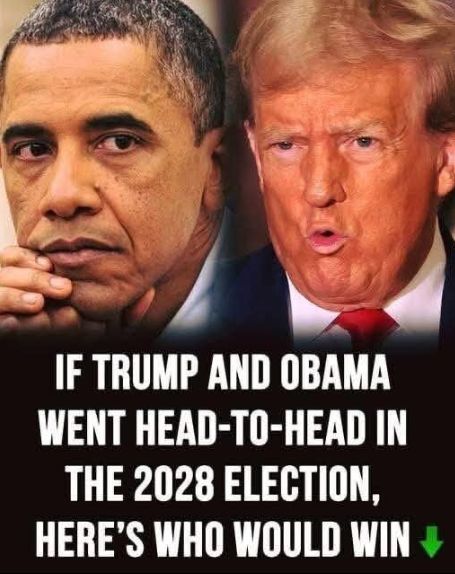
If Obama and Trump Went Head-to-Head
It was a night unlike any other in American media history. For months, rumors had circulated, speculation had brewed, and commentators had filled endless airtime with predictions. But nothing compared to the moment the networks officially confirmed it: Barack Obama and Donald Trump had agreed to go head-to-head in a live, unmoderated, uncensored national conversation.
Not a debate.
Not an interview.
A conversation—just the two men, at the same table, no script, no rules.
The anticipation was electric. Millions tuned in. Every news channel carried the feed. People watched from bars, living rooms, phones, airports, even outdoor viewing screens set up in cities across the country. For one night, the nation’s fragmented attention converged on a single moment.
The Stage Is Set
The set was simple: a round table, two chairs, soft lighting, and a camera that circled slowly to capture every angle. No audience. No moderators. Just two former presidents, face-to-face for the first time in years.
Barack Obama arrived first—calm, steady, wearing the same relaxed half-smile he carried through his presidency. He adjusted his suit, took in the room, and nodded politely at the crew.
Minutes later, Donald Trump walked onto the set—confident posture, familiar stride, radiating energy and charisma. He pointed at one of the cameras, gave a thumbs-up, and took his seat.
For a moment, they just looked at each other.
Not with hostility.
Not with warmth.
But with the unmistakable awareness that history had brought them back together.
The producer counted down:
3… 2… 1…
The red light blinked on.
Round 1: Vision vs. Momentum
Obama began with his signature measured tone. “Well, Donald, I suppose the country wants to hear us talk. So let’s talk.”
Trump smirked. “I’m ready. Always ready. The people want honesty, Barack. They want strength. They want success. And I gave them a lot of success.”
Obama nodded. “You definitely brought energy. And you tapped into something real. Anger, frustration, fear, hope—it was all there. But you and I had very different approaches.”
Trump leaned forward. “You were too slow. Too polite. Too worried about what other countries think. I came in and got things moving.”
Obama didn’t flinch. “And sometimes, moving fast means knocking things over.”
The contrast was immediate and unmistakable:
-
Obama: calm, analytical, steady
-
Trump: bold, rapid-fire, instinct-driven
The table became a microcosm of America itself—two worldviews, two leadership styles, colliding without restraint.
Round 2: The American Identity
The conversation shifted naturally into what “America” really meant to each of them.
Obama spoke about unity, shared values, and the strength of institutions. He talked about immigration as the fuel of national identity, about democracy not just as a system, but a moral obligation.
Trump countered with a different narrative—of borders, economic power, national pride, and a vision of leadership centered on force, negotiation, and advantage. He boasted of deals made, promises kept, numbers that still flashed across campaign ads.
“America needs to win,” Trump declared.
“America needs to belong to everyone,” Obama replied.
Neither man raised his voice. Neither interrupted. Yet the tension was palpable, a crackling static between two opposite poles.
Round 3: Regrets and Reflections
The producers didn’t expect this part—they thought the conversation would stay political. But something shifted. The tone softened.
Obama looked at Trump for a long moment before speaking.
“Do you ever think,” Obama said quietly, “about how heavy this job really is? How much it takes out of you? Out of your family?”
For the first time, Trump paused.
“I think about winning,” he said. “I think about what I did. What I could’ve done. I think about how unfair the media was. They never let up.”
Obama nodded. “They didn’t let up with me either.”
For a brief moment, they weren’t adversaries. They weren’t figureheads for movements. They were two men who had carried the same impossible responsibility.
Trump’s voice softened. “It changes you.”
“It has to,” Obama answered.
The camera caught something raw—a mutual understanding neither had acknowledged publicly before.
Round 4: The Nation Watches
Online, the reactions flew faster than the conversation itself.
-
Some viewers cheered Trump’s bluntness.
-
Others praised Obama’s poise.
-
Some were shocked they weren’t screaming at each other.
-
Others were stunned to see moments of unexpected respect.
For the first time in a long time, the country wasn’t arguing about which side was evil. They were watching two former leaders grapple with the weight of history.
Round 5: The Final Exchange
As the final minutes approached, the producer signaled the end. But neither man seemed eager to stop. It was Trump who leaned back, arms crossed, and spoke with surprising sincerity.
“You know, Barack… we’ll never agree on anything.”
Obama smiled slightly. “We might agree on more than you think.”
“Maybe,” Trump said. “But we’re different. We’ll always be different.”
“That’s America,” Obama replied. “It’s supposed to hold differences. Strong ones. Loud ones. But we lose everything if we forget how to speak to each other.”
Trump exhaled. “Well, we’re speaking now.”
“Yeah,” Obama said softly. “We are.”
A long silence followed—an unexpectedly meaningful one.
The Sign-Off
When the cameras finally cut, the country, for once, wasn’t shouting.
They were processing.
Not because either man won.
Not because either man lost.
But because the nation had witnessed something rare:
Two opposing forces sharing the same table, speaking—not shouting—across a chasm that millions of Americans struggle with every day.
Obama and Trump stood from their chairs.
They shook hands.
Not warmly.
Not reluctantly.
But with a mutual acknowledgment that leadership, in any form, comes with a price only the two of them will ever fully understand.
The broadcast ended.
But the conversation it sparked had only just begun.